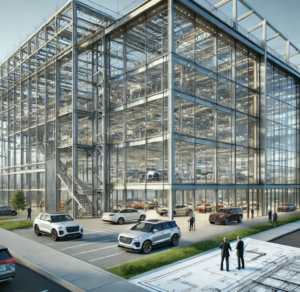
Car dealerships are not simple retail boxes. They are high-traffic sales environments, service-production facilities, brand showrooms, customer lounges, parts warehouses, delivery bays, and increasingly EV-ready technology hubs—all operating under strict manufacturer standards and tight timelines. When a dealership expands, renovates, or builds from the ground up, the project has to protect daily revenue while meeting brand image requirements, code compliance, and customer expectations. Construction Modeling makes that possible with far fewer surprises and far more control.
Construction Modeling, often delivered through Building Information Modeling (BIM), gives dealers a digital, buildable version of the project before crews ever break ground. It connects layout, systems, phasing, schedules, and costs into a coordinated plan that helps owners, GMs, facility teams, architects, contractors, and OEM programs move in the same direction. The end result is a dealership that opens sooner, operates smoother, and costs less to maintain. ✅
Dealership construction is booming, and the stakes keep rising 📈
Across the industry, facility upgrades are happening constantly—driven by OEM image programs, buy-sell activity, the shift toward EV capability, and the need to deliver a modern customer experience. That pace creates pressure: shorten build timelines, reduce disruption, and avoid costly change orders while still delivering a facility that meets brand standards. Industry coverage has highlighted how frequently dealership construction projects are appearing and how closely they are tied to manufacturer requirements and competitive positioning in automotive retail. A useful snapshot of this broader trend appears in AIADA coverage of dealership construction projects.
When projects are this common and this complex, the dealerships that treat construction like a controllable system—not a hopeful gamble—gain a real operational edge.
Construction Modeling reduces downtime during phased renovations 🛠️
One of the hardest problems in dealership construction is staying open while construction happens. Sales can’t stop, service can’t shut down, deliveries still need to roll, and customer experience still needs to feel professional. Construction Modeling supports phased construction planning by allowing teams to simulate how the dealership will operate during each phase: temporary entrances, alternate service lanes, customer parking shifts, service write-up workflows, parts deliveries, and safe separations between customers and work zones.
When the model is paired with phasing and scheduling, a dealer can see conflicts before they happen. For example, a planned demo zone might block a critical path to the service drive, or a temporary wall might interfere with ADA routes. Modeling helps prevent “we’ll figure it out in the field” moments that cause delays, frustration, and lost service hours. This idea of maintaining operations through intentional phasing is commonly discussed in dealer-focused construction coverage, including CBT News on phased construction for auto dealerships.
This is not just a construction benefit. It is a revenue-protection strategy.
It aligns the facility to modern retail expectations and manufacturer image programs ✨
Customers expect a dealership to feel seamless: clear wayfinding, comfortable waiting areas, strong lighting, modern finishes, and a sense that the store is current. Manufacturers expect consistent brand presentation and often require upgrades to signage, façade systems, showroom layouts, delivery areas, and customer amenities. The gap between “a nice renovation” and “a compliant, brand-forward facility” is where many budgets blow up.
Construction Modeling helps ensure the design intent matches what is actually being built. It also helps stakeholders review the dealership experience before construction starts—sightlines from the entrance, the flow from showroom to finance offices, the path from service drive to lounge, and the visibility of key brand elements. Dealer-focused industry content frequently emphasizes how upgrades are used as growth opportunities when managed with strong planning and coordination, including Digital Dealer’s discussion on embracing dealership upgrades.
When a dealership must meet standards and protect customer experience, “clear in the model” beats “interpreted from drawings” every time.
It prevents expensive MEP conflicts in service bays and shops 🔧
Service departments are the production engine of a dealership. They rely on dense, coordinated systems: lifts, compressed air, exhaust extraction, electrical capacity, data drops, plumbing, trench drains, oil-water separators, fire suppression, HVAC zoning, and increasingly EV charging and high-voltage safety requirements. These systems collide in real life when they are not coordinated in the planning stage.
Construction Modeling is especially valuable for MEP coordination because it identifies clashes before installation. A duct run might conflict with a lift bay clearance. A conduit bank might interfere with slab thickness or trench drains. A sprinkler main might conflict with signage structure or ceiling heights in customer-facing areas. Every one of those conflicts becomes time, money, and disruption—often right in the middle of business operations.
By coordinating systems digitally, dealerships can reduce rework, speed inspections, and protect the schedule. That is the kind of behind-the-scenes win that customers never notice, but owners feel in the numbers.
It improves schedule and cost certainty in a volatile environment 💰
Dealership projects frequently run under tight deadlines tied to OEM programs, grand openings, and operational needs. At the same time, construction markets can face labor constraints, lead-time variability, and pricing shifts. Construction Modeling supports better forecasting because it enables tighter quantity takeoffs, more accurate sequencing, and earlier decisions on procurement.
When modeling is combined with schedule and cost planning, leadership gains clarity on what is truly “critical path” and what can be adjusted without risking open dates. This kind of planning discipline is often highlighted in dealership design and construction guidance aimed at keeping projects moving despite extended timelines. One example is Truist’s dealer-focused coverage on facility upgrades and strategies to keep projects on track: Truist Dealer Services on building tomorrow’s dealerships.
For a dealership, certainty is not comfort. It is leverage: better decisions, fewer surprises, and stronger negotiating position with vendors and contractors.
It supports EV readiness and future-proofing the facility ⚡
Even dealers not fully invested in EV sales still face a future where EV service capability, charging infrastructure, and electrical capacity matter. Construction Modeling helps teams plan power distribution, charger placement, service bay layouts, ventilation needs, fire protection coordination, and safe customer routing—before walls go up and slabs are poured.
Modeling also helps anticipate future growth by allowing “what-if” scenarios: adding chargers later, reconfiguring bays, expanding parts storage, or adjusting customer lounge footprints as digital retailing and appointment-based service evolve. This is a practical approach to flexibility, not an abstract tech upgrade.
As the retail environment changes, dealership facilities are adapting as well—often through rethinking layout and space usage. The wider shift is discussed in dealership facility design coverage such as Dealers Choice on facility design adapting to shifts in auto retailing.
A model lets a dealer build for today without trapping the store in yesterday’s assumptions.
It strengthens communication across owners, contractors, and OEM stakeholders 🤝
Dealership construction involves a crowded room: dealer principals, general managers, fixed ops leaders, OEM facility teams, architects, engineers, general contractors, subs, inspectors, and sometimes lenders. Miscommunication is common because each group speaks a different language—operations, compliance, design intent, constructability, or finance.
Construction Modeling provides a shared visual truth that reduces misunderstandings. It becomes easier to review layouts, confirm clearances, validate phasing plans, and catch problems early. Instead of arguing over interpretations of 2D drawings, teams can coordinate from a single source of alignment.
This is especially important in high-visibility projects where brand presentation matters. Facility openings and redesign concepts are frequently covered in dealership industry news, such as Auto Remarketing’s reporting on OEM design concepts in newly opened stores, including Auto Remarketing on Honda’s design concept at a new dealership.
Better alignment leads to fewer delays, fewer change orders, and fewer tense meetings when time is tight.
Conclusion: Construction Modeling turns a dealership build into a controllable business investment 🏁
A dealership’s facility is not just a building. It is a sales engine, a service factory, and a brand promise customers can see and feel. Construction Modeling helps protect that investment by reducing downtime, improving coordination, preventing costly system conflicts, strengthening schedule and cost certainty, and enabling a facility that fits the way modern dealerships actually operate.
When the industry is actively modernizing and upgrading stores, the difference between a smooth project and a painful one often comes down to planning quality and coordination. Construction Modeling raises both. It helps leadership make decisions with confidence, keeps operations moving during renovations, and delivers a finished facility that supports customer experience and fixed ops productivity for years.
For a baseline definition of what a dealership is at its core, see Wikipedia’s overview of car dealerships.
